
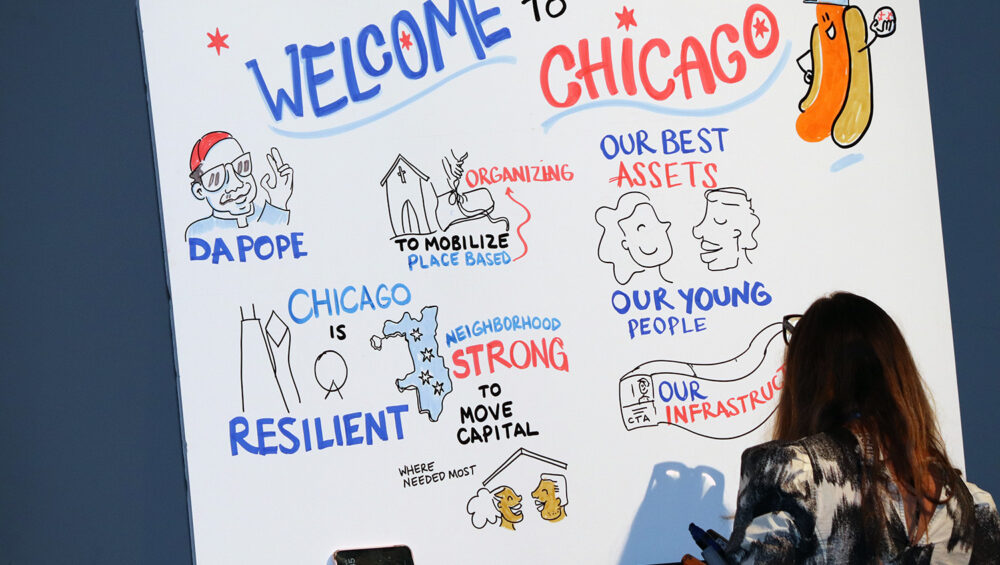
Earlier this month, the Neighborhood Economics conference came to Chicago – a city alive with energy, creativity, and a fierce commitment to building stronger, more connected neighborhoods. Opening remarks from Alison Clark, the Associate Director of Impact Investing at the MacArthur Foundation, and one of the event’s key sponsors, set the tone with reflections on Chicago’s legacy of “discovery, recovery, and evolution.” What transpired that week was more than a conference. It was a gathering of visionaries and a weaving together of people, possibilities…and of course capital.
Already a cornerstone in the world of impact investing, Neighborhood Economics is quickly becoming a space where leaders shaping the future of local economies gather. As conversations have continued following the event, numerous cohorts are forming, from working groups to build a collaborative catalogue of what is working in neighborhood impact to another group working to address how to unlock funding for loss reserves to get mission focused capital on the streets. (This topic is becoming more critical as the administration moves to shut down the CDFI program, originally created by the Department of Treasury in1994 under the Riegle Community Development and Regulatory Improvement Act.).
Tim Freundlich of Impact Assets observed this coming together as he reflected from the main stage. “The emerging funds and partnerships represented in this room resemble an archipelago – small islands of coherence and innovation where systems thinking is alive and well. We need to throw a big party and get us all together,” he said. “But maybe… that’s what is happening here.” And indeed, that is what transpired. The Chicago gathering became a celebration of what is possible when capital meets community and a place to begin charting new roadmaps across the islands..
At its core, Neighborhood Economics is built on sparking unexpected collaborations that lead to breakthrough strategies, and one such story illustrated exactly that. At the April gathering in Asheville earlier this year, locals Luke Lingle and Clark Harris, by pure chance, crossed paths at the event, and in their desire to find a “running partner” in their parallel work, they uncovered the potential of joining forces. Out of that meeting came New Chapter Ventures, an endeavor (and fund) to reimagine underutilized assets like churches as vital community resources.
This time around, the pair took to the stage in Chicago to share the story of how their new model is now taking shape in Western North Carolina. Alongside other voices such as Peter Beeson from Realize-Real Estate as Ministry, Mark Sampson from Rooted Good, Emily Sajdak of Partners for Sacred Places and May Yu with Trinity Church Wall Street, they urged churches to embrace their role as anchors of community life. The group believes preserving sacred spaces through adaptive use, such as affordable childcare or meal services, can reduce community reliance on government systems for critical infrastructure and allow faith institutions to generate sustainable cash flow.
What unfolded in Chicago echoed an even larger truth: the growing recognition that genuine transformation begins where trust and power converge. In session after session, the theme was clear: trust-based relationships move capital differently. The MacArthur Foundation’s early bet on Lyneir Richardson and his vision for Chicago TREND stood out as a powerful example of that idea in practice. Richardson’s model of investing in community shopping centers blends institutional capital with shared ownership, enabling community members and small impact investors to financially benefit from the revitalization of their own neighborhoods. The trust and support of MacArthur and other institutions has helped to make this model more visible, allowing it to replicate, scale and attract the attention of further investors and partners.
But this example is more than a single success story. As cities across the country grapple with how to confront inequity, Chicago stands apart. Its advantage isn’t just in strategy, but is perhaps born from the city’s rich history of community organizing. Chicago’s social capital runs deep, laying the groundwork for an ecosystem of collaboration that many other cities are only beginning to build. Leaders who grew up in the same neighborhoods they now serve are shaping the city’s future together. They embrace systemic thinking at scale, creating channels of trust that allow catalytic capital to flow in ways few other places can match.
The partnership that has developed between Pat Ford of the Steans Family Foundation and Richard Townsell of the Lawndale Christian Development Corporation (LCDC) is a powerful example of this dynamic. Growing up on the same blocks, Townsell and Ford’s organizations are now leading one of the city’s, perhaps even the nation’s, most ambitious neighborhood revitalization efforts. North Lawndale is a community that was once home to Dr. Martin Luther King Jr. It faced continued disinvestment, which accelerated after riots broke out in the wake of Dr. King’s assasination in 1968.
Townsell, along with United Power for Action and Justice, is rewriting the narrative through the Reclaiming Chicago initiative. The project aims to build 2,000 quality homes across Chicago’s South and West Sides, made affordable by deep state subsidies. It doesn’t treat residents as passive recipients of aid but demonstrates what real power looks like, not as a force of control but of care and community, building individual wealth for working families and transforming geographies of vacant lots into living, thriving neighborhoods once again. When asked how other foundations can learn from the example set by Steans, Ford noted the importance of leading with time and intentionality to nurture the relationships. “The responsibility is on the funders,” she said in a bold call to action, “to leverage the playing field for community good.”
While one side of LCDC’s work emphasizes the importance of individual ownership, the other side, championed through the initiatives of its Deputy Director, Whitney Smith, addresses an equally critical issue: collective stewardship. For generations, owning a home has symbolized stability, dignity, and belonging, yet that dream has often been threatened by redlining, predatory lending, and waves of displacement. As Smith noted in her breakout session on shared ownership, “If we want to recreate these models, I want all of us in the impact investing space to be in honest and open conversation about how we think about resource deployment and be cautious about the application of dominant market forces to these community spaces.”
Conversations about community ownership carry both hope and complexity. Cooperative and shared ownership models ask communities to reimagine control and security after decades of fighting for land and agency. Navigating that shift requires immense trust – trust that pooling ownership can strengthen, not diminish. The Community WEB (Community Wealth Ecosystem Builders), under the leadership of Nneka Onwuzurike and alongside Xochitl Espinosa of the Co-op Ed Center, cultivates relationships across communities and policy spheres to build the infrastructure for these models – from worker cooperatives to community land trusts and community investment vehicles. All together, they demonstrate how cooperative approaches, rooted in deep relationships and shared vision, can help residents not only keep their place but shape its future and build collective power.
A large institution like Rush University Medical Center carries its own unique kind of power—and with it, a profound responsibility. As a member of the Healthcare Anchor Network, a group of 75 healthcare systems across the country, Rush has pioneered a national model for how hospitals can align their influence with community well-being. Under the leadership of Dr. David Ansell, author of The Death Gap: How Inequality Kills, Rush helped write the playbook for what is now known as anchor mission work. Anchor mission work is a commitment to intentionally apply an institution’s long-term, place-based economic power through hiring, purchasing, and investing to advance shared prosperity in the communities where they have a footprint.
This work in action can be seen through its partnership with West Side United, a health equity coalition that Rush helped to found in 2017 as a collective effort to help dismantle barriers to health. In 2021, when a local Aldi on the West Side abruptly closed its doors, leaving 15,000 residents without access to fresh food, WSU was able to respond to the crisis with quick action, working with local organizers to deploy a pop-up grocery store. What emerged as a temporary solution in response to a crisis has now led to a long-term development plan for the former Aldi location that will include a new grocery store, a restaurant and affordable housing.
In a panel moderated by Doug Jutte, founder of the Build Healthy Places Network, Nathalie Rosado, Julia Bassett and Ian Hughes from Rush joined Ricardo Saucedo and Eve Shapiro from West Side United to reflect on how they are addressing the social, environmental and economic determinants that affect well-being and health. Bassett described Rush’s Food Is Medicine program, which systematically screens patients for food insecurity and connects them to resources like the on-site pantry and Veggie Rx—a partnership with Forty Acres Fresh Market that delivers fresh produce, recipes, and nutrition education directly to patients’ homes.
Rush’s anchor mission also reaches into sustainability through its Five Pillars of Impact: climate, waste, resources, purchasing & people. Hughes, Rush’s Director of Environmental Sustainability went on to detail how the hospital affects environmental determinants of health through its sustainability goals. As part of the Impact Purchasing Commitment, Rush joins 14 health systems in the Healthcare Anchor Network in aligning their purchasing power with community health goals, prioritizing local, sustainable vendors that build community wealth. The hospital also addresses food waste by donating nearly 20,000 pounds of surplus food per year to Franciscan Outreach and partnering with organizations like Green Era to divert food scraps to offsite composting and biodigester locations that produces renewable energy and nutrient-rich soil, creating a closed loop of care from hospital to community to environment.
Shapiro also elaborated on how their work at West Side United leverages the economic power of anchor institutions to support local businesses and drive place-based investments. A groundbreaking example of this work can be seen in the development of The Fillmore Center, a collaborative project that combines targeted job creation, small business support, and community assets. The Steans Family Foundation purchased the property in November 2022 for $3.3 million, and renovations were funded through tax credits and grants, including support from the Chicago Community Trust. In 2024, Fillmore Linen Service, a laundry facility inside the center, opened with Rush as its first customer. The move localized services that had previously been outsourced to other states and created 175 quality jobs for residents on the city’s west side. This initiative demonstrates how anchor institutions, philanthropy, and community organizations can align resources to create sustainable economic opportunity.
Along the same lines of place-based investment, the concept of investing in corridors is not new. Indeed, it has formed the scaffolding on which cities and towns were first imagined and built. But today, this focus of development is re-emerging as a powerful strategy for community repair. Colette English Dixon, Executive Director of the Marshall Bennett Institute of Real Estate at Roosevelt University, hosted a conversation that highlighted the importance and complexity of revitalizing these critical spaces.
Dixon was joined by Ja’Net Defell, who launched Community Desk Chicago (CDC) in 2023 as a community development intermediary to empower under-resourced communities through ecosystem strategy, technical coaching, and capital coordination. Through its CorridorLive! program, CDC targets key properties to cluster development and create vibrant, connected corridors. As Defell emphasized, “Neglected corridors take a toll on quality of life, safety, and community well-being. Thoughtful, phased development not only restores the vibrancy of these neighborhoods but also brings economic opportunity, density, and access to essential goods and services.”
Uzma Noormohamed from Chicago Frontlines Funding Initiative also added to the conversation by addressing the topic of industrial corridors. Chicago has 26 industrial corridors that intersect residential neighborhoods, many of which face the city’s highest rates of asthma and other pulmonary diseases. Historically, marginalized communities have borne the brunt of industrial waste and landfills, an issue that was originally made visible by the work of Hazel Johnson. Johnson was the mother of the environmental justice movement who pioneered citizen-driven data collection. “Residents remain deeply committed,” Noormohamed said, “they don’t just want to fight; they want to see something beautiful built.”
Throughout the conference, countless stories illuminated what is possible when vision meets community. David Erickson from the New York Federal Reserve urged participants to see their work as part of a larger living system. He invoked the concept of a fractal, imagining how the flow of a river eddy mirrors the spinning of a hurricane in the Gulf, which in turn reflects the rotation of the Milky Way stars. “We can see how local models – like Lyneir Richardson’s work at Chicago TREND – are proving successful at the stream leve,” Erickson said. “The challenge is building the pipeline that allows these successes to ripple outward to reach the galaxy scale.” Doing so requires intentional coordination, catalytic investment, and proper infrastructure – roles that both government and philanthropy are uniquely positioned and have a responsibility to play.
As the gathering drew to a close, participants shared their hopes for next steps for Neighborhood Economics, from widening the conversation around property tax reform with Cook County Assessor Fritz Kaegi and Dr. Chris Berry, to more deeply exploring the technical details of new vehicles for community wealth.
Many called for Aisha Weeks to share further on the story of the Dearfield Fund, a groundbreaking initiative in Denver that helps first-time homebuyers bridge the down payment gap by providing up to $40,000 in deferred, no-interest assistance.
Others, like Stephanie Swepson Twitty of Eagle Market Streets Development Corporation, expressed interest in diving deeper into earned-income strategies alongside Mia Solberg of RSF Social Finance. The proposed session would guide participants from concept to implementation, covering four key steps: (A) The Dream You Dream, (B) The Puzzle Pieces, (C) The Capital Stack, and (D) “Wash, Rinse, Repeat”—the ongoing path to resiliency.
As discussions continue and the next gathering begins to take shape, a roadmap across the islands is emerging; still a glimmer, but growing clearer. Neighborhood Economics continues to connect the dots between people, projects, and places, marshalling local brilliance into shared momentum. What began as scattered sparks of innovation is forming a constellation of models that show what is possible when communities lead and institutions listen. The work ahead is vast, but the path is taking shape—and this is only just the beginning. To be a part of this journey, you can follow along on Linkedin, sign up for the newsletter or submit your info here to join the live discussion in the ongoing event’s Google Group, including access to the working groups currently being formed.
Image: Live note-taking on stage at Neighborhood Economics Chicago 2025.