
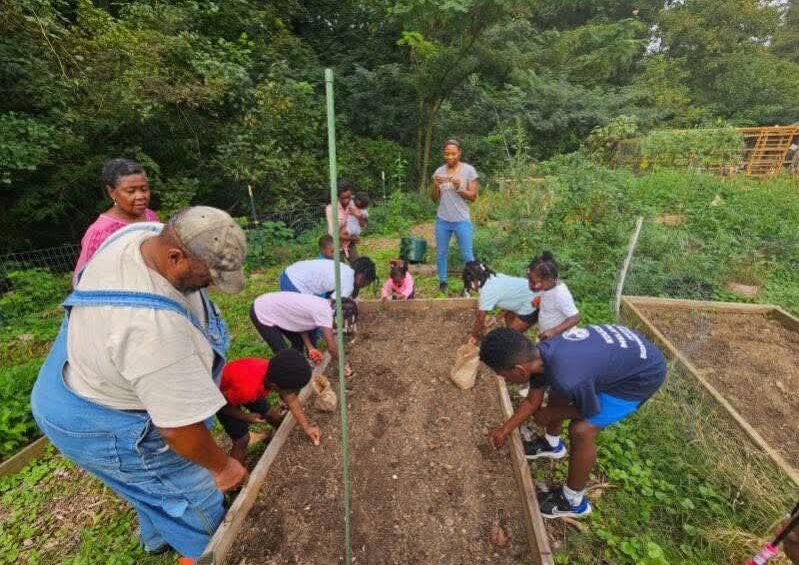
Photo courtesy of East Tennessee Farmland Commons
Food justice is often talked about in the context of addressing food deserts, with the goal of getting a grocery store or setting up a community garden to increase access to healthy options. But at The Farmers Land Trust, a national nonprofit transacting farmland into community ownership, food justice is about regenerative agriculture and resilient food systems.
The Farmers Land Trust has set up local Farmland Commons in seven states with ongoing conversations with a total of nineteen, each functioning to address access to land, skill local farmers, and create a sustainable model of ownership. The fractional nonprofit ownership structure comes by way of a 501(c)(25) nonprofit-holding designation that has existed since 1986, used mostly in medical and religious contexts. However, The Farmers Land Trust has adapted it to allow multiple nonprofits and community organizations to hold farmland as equal owners. (Learn more in Kevin’s piece A Legal Innovation That Lets Communities Own Their Farmland.)
East Knoxville’s Stories
Enter the neighborhoods of East Knoxville. With the Farmland Commons model catching on nationally and residents of these neighborhoods living in food apartheid, the area’s growing reconnection to its own rich history of Black farmers led leaders into conversation with The Farmers Land Trust team to set up the East Tennessee Farmland Commons (colloquially known as “The Commons”). In East Knoxville, the community reclaimed their story through elders’ recollection and flexible funding from an anchor institution that catalyzed the storytelling.
In early conversations, the close group of nonprofits working toward food justice were hesitant. Tanika Harper is Executive Director of one of the founding organizations of The Commons, The Shora Foundation. She reflected on the history of Black residents’ displacement and lack of access in East Knoxville. She was skeptical about the idea of creating a land trust: “Was the land really going to be protected?” she asked. “Or is this just another way for the government to come back later and take something that doesn’t belong to them?”
However, the social infrastructure in Knoxville is strong. The Shora Foundation and Rooted East Collective, two of the founding organizations of The Commons, share a co-working space. After bringing together the network of nonprofit leaders working toward food justice to have a collective conversation, the decision was made clearer. It was the social capital among each other and with Kimberly Pettigrew, Director of Food Systems at the United Way of Knoxville, that was key to remembering the lost history of Knoxville’s food system and therefore catalyzing the land trust proposal.
An Ecosystem at Work
In a conversation with Neighborhood Economics, The Shora Foundation and Rooted East Collective identified the elements of the food justice ecosystem. What once was a collection of individual actors filling their own niche in food justice became the collaborative ecosystem needed to establish the East Tennessee Farmland Commons. What brought them together was an uncovering of a lost memory of local food systems.
Pettigrew and United Way utilized flexible philanthropic money to partner with Three Cubed, a local researcher and evaluator integrating economic sustainability, to assess and pilot food justice solutions. The assessment gathered the nonprofit leaders to properly situate the community’s relationship and experience with food systems. What emerged was a hidden memory that most of the community was unaware of: a rich history of Black farmers in East Knoxville. The food access conversation then involved elders who held the local memory and shifted to deeper systems questions about land, stewardship, and who gets to build lasting community wealth. In operating from a deeper place of questioning land access, the opportunity to imagine a land trust owned by the community began to develop.
When the local nonprofits in food justice began conversations with the national Farmers Land Trust team, they were met with surprise at the level of collaboration already present in the work. Whereas the typical Farmers Land Trust undergoes a process of identifying who takes part in the fractional ownership, East Knoxville’s collective memory and collaboration provided a ready group of players. “We already had all the partners at the table,” Harper shared.
This was the first Farmland Commons that was ready to launch without supervision and guidance from The Farmers Land Trust. Farmers were being skilled, gardens being cultivated, and the social infrastructure was already in place to sustain the ownership model. Recovering the identity of an abundant food system was inherent to the work of each food justice niche in East Knoxville.
What Made the Innovation Possible?
The East Knoxville ecosystem includes elders, farmers, and nonprofits across the food justice system. It has ultimately linked food justice with entrepreneurship and economic development. Rooted East, for example, works to skill urban farmers in agricultural practices, cooking, and gardening—all the skills needed to sustain a local food system. The land designation even holds the capability to build housing on the land, a necessary infrastructure for a complete livelihood. The structure allows farmers to learn the skills in urban settings and “graduate” to farming on acres of local land. With this structure in place, the Farmland Commons allows farmers to scale with five to ten acre farms that are currently out of reach to urban residents.
The anchor institution did not come in with a top-down plan of how to improve the system. Instead, they mobilized funding to assess what was already being done and what the story of the community was. The national “consultant” did not need to build a new ecosystem, but was met with a ready-to-scale social infrastructure. Locals were prepared and collaborative under a shared commitment of restoring a lost memory of food system resiliency and ownership.
The example in East Knoxville demonstrates the capability of local communities to replicate food justice owned and operated in the community. The story was uncovered through a seldom-funded evaluation of a community’s story – a history of Black farmers who once had ownership and means to feed their neighbors while earning a living. Their story is not one of creation and new ideas, but of food system restoration through an ecosystem committed to reclaiming their heritage and economic sustainability.