
I was thinking of work like what Lyneir Richardson and his company, Chicago TREND, had done twice: buying back the block, saving businesses in the neighborhoods where marginalized people live, preventing them from being gentrified out by predatory hedge funds who are increasingly turning neighborhood real estate into financial assets valuable only to predatory investors.
Richardson’s model, which had resulted in the sale of a shopping center, had made more than 350 locals a six-times return on their small-dollar investments toward helping their own community thrive through ownership. That model of buying back the block has been turned by Richardson and the Brookings Institute into a workbook, and the model is being replicated in a half-dozen cities, from Baltimore to St. Louis to Memphis.
David Bank of ImpactAlpha, the Wall Street Journal of impact investing with a growing focus on local solutions, has also been compiling a list of new and innovative financial solutions that created the conditions for everyone in a neighborhood to thrive and progress toward community health and intergenerational wealth.
So replication was the big news coming out of the conference. People wanted to dive deep on how to import the solutions being talked about on the stage into their own cities and towns. One church from a rural area had brought nine people wanting to figure out how to gather the catalytic philanthropic investment capital needed to actualize a plan to solve the transportation problem in their community. They’d discovered people were not doing well because they were stuck out in the country with no way to get to the services and care they needed.
But at 11 am, I saw what I have a hunch is the next phase of the market for repairing the local economy: interoperability, where solutions work together in ways that add to the effectiveness of each intervention.
It happened spontaneously, during the Q&A time. The session had been about using soft capital to make housing more accessible than traditional affordable housing.
The Dearfield Fund has found a patient long-term philanthropic investment mechanism that provides the down payment for people who can afford a mortgage but would likely never be able to gather the $40,000 needed to get started in a modest house.
Meanwhile, Sam Centellas of CDFI Friendly South Bend had, thanks to cooperation between a CDFI and a Credit Union, created a tool that provided the missing capital (in the form of a revolving equity investment) to help a would-be affordable housing developer close deals. The equity would then come back and be reused.
Both of these innovations are significant. A fund looking to replicate The Dearfield Fund’s model was also on the panel.
The Q&A participant, looking to launch a housing fund in a low-status neighborhood at risk of gentrification, asked which of the tools should be used first, South Bend’s or Dearfield’s. Which would be most able to help them house the people in the neighborhood—one in six of whom had either lost their home and had it become uninhabitable due to Hurricane Helene?
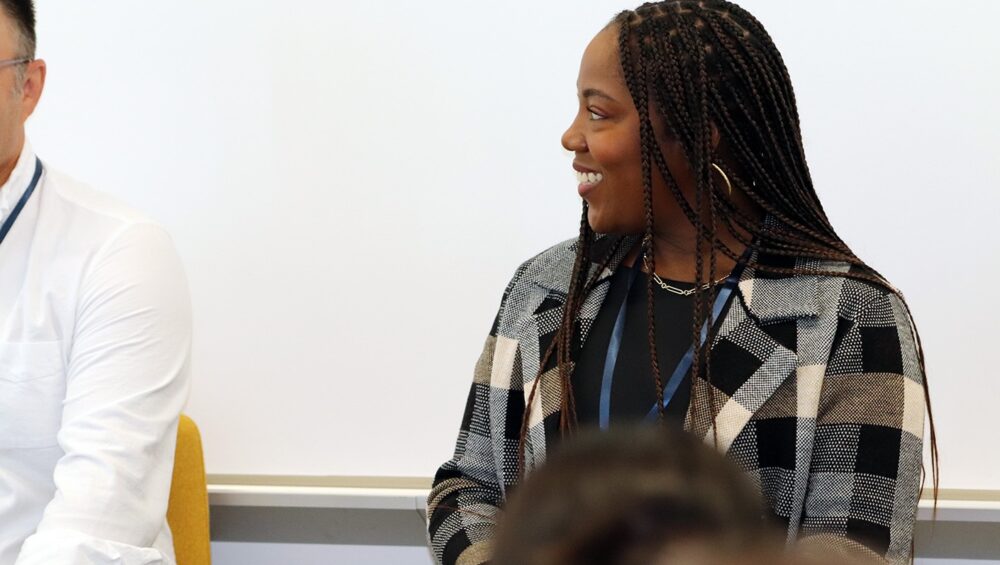
Stopping to think a minute, Dearfield’s Aisha Weeks said that, actually, they should be tried together. Dearfield gets a prospective low income homeowner $40,000 closer to becoming an owner of an asset that would both appreciate and keep them safe from displacement. But South Bend made it easier for the affordable housing developer to make sure that housing got built, by about $25,000.
Together, those two solutions could lower the cost of home ownership by up to 25% . They were better together.
That’s the heart of the story from Neighborhood Economics Chicago 2025. There are more solutions than when we started this event series a decade ago, and some of those solutions are stronger when added together.
Image: Aisha Weeks, Managing Director of The Dearfield Fund, at Neighborhood Economics Chicago 2025