

Image courtesy of NC3
Tracy Loh studies community capital at Brookings Institute, Metro. When she talks about the Diversified Community Investment Fund — the DCIF — the first thing she says isn’t about returns or impact.
“It’s already legal,” she told me. “It doesn’t require any action on the part of Congress, or a state legislature, in order to happen.”
That’s the sentence that should stop people. The DCIF works inside securities law that already exists — which is why it’s showing up in Rhode Island, Michigan, and Georgia, and about a score of states and now, quietly, in rural Maine, in a way that shows it’s replicable adaptability.
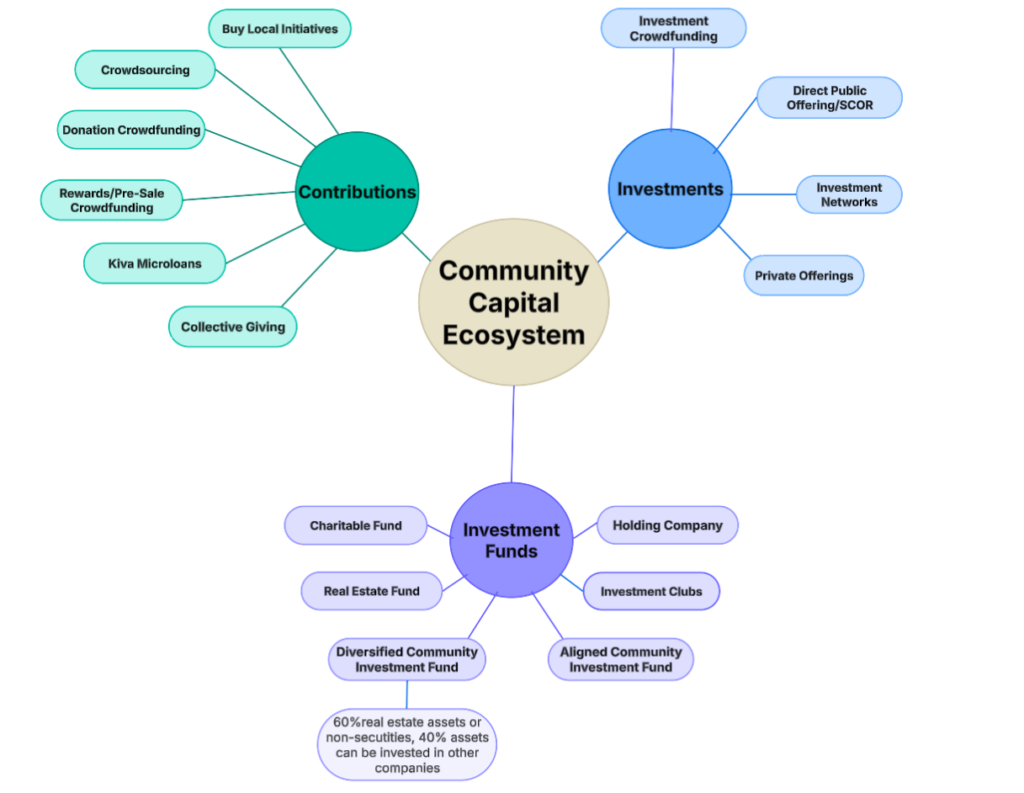
Image courtesy of NC3 and Crowdfund Better
What It Actually Is
Chris Miller, CEO of the National Coalition for Community Capital (NC3), spent his first decade getting state crowdfunding exemptions passed so residents could invest in businesses on their own block. It worked, but was only a slice of what communities needed.
The breakthrough came from a conversation Miller and securities attorney Brian Beckon had with a Rhode Island group that wanted to launch an angel fund and couldn’t. That was the moment, Miller says, that got him thinking about pairing community investment with real estate. NC3 has been building the Diversified Community Investment Fund ever since: roughly 60 percent of local capital into commercial real estate likely to appreciate, the rest into local businesses. The real estate anchors the fund and lowers its risk; the businesses get the benefit.
“A $150,000 DCIF is just as believable as a $150 million DCIF,” Loh said, “depending on who is doing it, what it’s for.”
Low transaction costs and easy integration with crowdfunding platforms like WeFunder and Honeycomb Credit let it scale down as easily as it scales up — unlike New Markets Tax Credits or angel funds, where a lawyer gets paid $100,000 no matter the deal size. It’s promising enough that the Kresge foundation has funded a multi-city cohort.
The Swiss Army Knife
The clearest proof is in Maine. Loh described a woman there running a manufactured housing operation — a real factory, hundreds of units built, a formal relationship with Maine Housing. She had investors ready and nowhere to put the money.
She’s a scattered-site developer, building housing statewide out of a catalog, the way Sears once sold houses by mail. A real estate syndicate is built for one property at a time; she couldn’t answer “which site” when the answer was all of them. Her investors were mixed too — some accredited, plus plenty of Mainers who could write a $10,000 check but nowhere near accredited-investor territory.
“She literally just needs an envelope to stuff her money into,” Loh said.
Two phone calls later, she was setting up a DCIF. The same structure that plugs an equity gap for a Michigan CDFI’s borrowers also solves a housing bottleneck in rural Maine.
Safer Than People Assume
The instinct to distrust crowd-sourced investing by people of average means doesn’t hold up in the data. Businesses that complete a successful investment crowdfunding campaign survive at roughly double the rate of small businesses generally, per research Loh reviewed for a paper she, Brookings, and Chris Miller wrote. The characteristics that lead to gathering a crowd of small dollar investors also lead to building a successful business; you create the conditions where people want you to succeed and get on board.
That baseline safety is what makes the DCIF consequential rather than clever. The appreciating real estate lowers the volatility of the whole fund, letting a manager take a bigger swing on an earlier-stage, catalytic business bet than it could carry alone. As DCIFs build a track record — dividends paid, businesses still open years later — that de-risking compounds. The more the model proves itself, the more catalytic it can afford to be with the next dollar.
The Case Brookings Can Make
Loh, Miller, and Brett Theodos at the Urban Institute are seeking funding for a multi-year study following several DCIFs through their full lifecycle. Asked what the best-case story looks like three years out, Loh didn’t reach for a growth chart.
“A business opens,” she said, “and doesn’t shut down, because it’s got appreciating real estate to reduce the risk of the investors.”
Because DCIFs pay dividends, the story doesn’t need a five- or ten-year exit — it can be as simple as: we bought something, and it’s worth something. Miller is bringing the whole NC3 board to Galveston in September for the Neighborhood Economics gathering. Loh will be there as the validator: a structure already working in enough places that a new city can look at Maine, Michigan, or Georgia and conclude — this will work here too.