
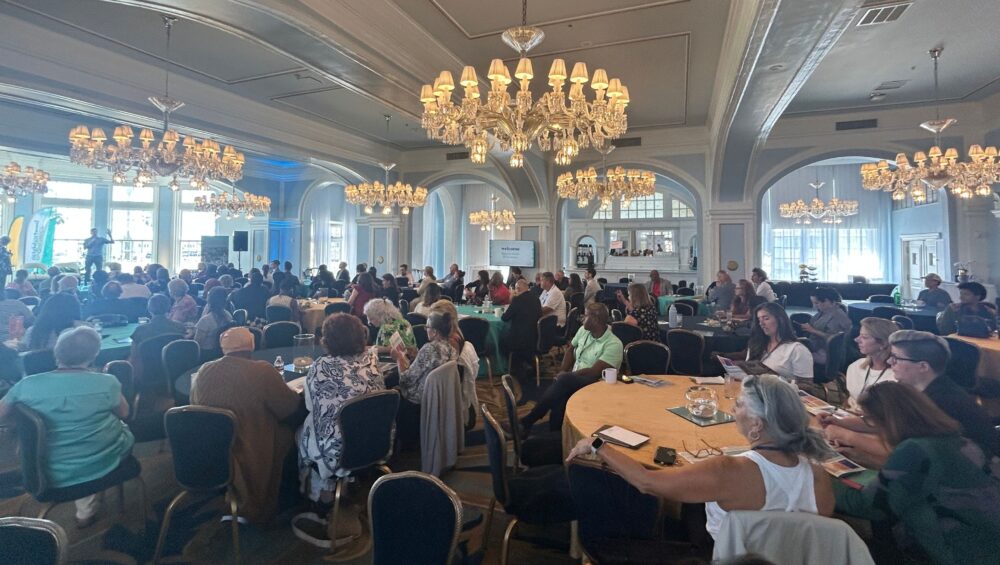
Most participants in Neighborhood Economics events know we are organized as a faith-friendly convener on the topic of local economic investment for resilience in left-behind neighborhoods. We recognize faith-based institutions as important stakeholders in those neighborhoods. Churches own assets, administer services, and shape local identity.
However, at our Galveston event, a new theme emerged as speakers and participants explored the role of churches in public conversations that matter. People of faith are both involved in organizing for economic justice and broadening the conversation about why this work is so important.
In preparing for our gathering, Neighborhood Economics partnered with the Episcopal Diocese of Texas and Episcopal Health Foundation to bring the church into conversations on community investment. Along the way, we also came to appreciate the richness of faith-based leaders’ involvement in community efforts already underway in the Lone Star State.
Faith (Already) In Action
The Episcopal Health Foundation sponsored more than 15 residents of Taylor, Texas, and 25 other Episcopalians from the state to attend Neighborhood Economics. The Houston-based nonprofit wanted people of faith at the table for conversations on topics including property tax justice, new capital stacks for community investment, and climate resilience.
Some of these attendees represented a critical mass of concerned residents already fighting a datacenter development on contested land in Taylor. According to news reports, the community-based HALT Taylor Data Centers organized a petition with over 1,400 signatures, and identified a deed for the proposed land that restricts its usage to a public park. The fight has caught the attention of Texas Attorney General Ken Paxton, who may see a political opportunity amid his tightly contested Senate race with Presbyterian seminarian James Talarico.
The proposed data center is particularly troubling to these Taylor residents after a 2022 deal that brought a Samsung chip manufacturing plant to the rural area under tax incentives and a promise of investment. The plant’s delays have pushed the expected initial operations to late 2026 and full manufacturing capability to 2030. Residents who have experienced the burden of the tax incentives and resulting rise in downtown rents are more skeptical of new developments in Taylor, despite Samsung’s investments in the local community. Uneven experiences of these investments are contributing to a range of trust in newly promised projects, including the new data center.
Recognizing Churches’ Role
The fight in Taylor is representative of a much wider trend across the U.S., a trend receiving increased media coverage. Residents are paying increased attention to local land use, affordability, and housing options. Amid this rising tide of interest, groups like the Episcopal Health Foundation are taking seriously the relevant questions of economic justice and the impact of development. The organization brought a wide range of residents to learn from experts at our Neighborhood Economics event, to share their stories, and better understand how a common pursuit of justice can unite stakeholders with differing perspectives
The role of local and regional churches in highly public and political tension is not easily covered by the mainstream media, so it’s no surprise this dimension has been missing from many accounts. Against this backdrop, Neighborhood Economics has an important role to play. We spotlight how faith-based organizing takes place—with churches perhaps not at the center of the debate but claiming their role as stakeholders, organizers, and conversation partners.
To miss the role of churches in such an important tension point to Americans everywhere is a failure to represent successes in working toward local economic resilience. When fighting wealthy corporations, entrenched power structures, and market influences beyond individual choices, a community needs to find ways to come together. That’s especially important when residents’ perspectives differ about how to achieve economic justice.
Neighborhood Economics and our partners take that role seriously. We will continue to be a convener that recognizes how churches are key anchors in their communities.
Want to hear more about one church’s role in the Taylor data center fight? Read Kevin Jones’s piece, “The church where people gathered.”